
Razor Returns — risk profile and mechanics (2026)

Razor Returns is often mixed up in briefs because it “feels” like a typical extreme-volatility title, but the official provider is Push Gaming, not Nolimit City. Either way, the practical question for players is the same: what parts of the rules create long losing stretches, and which features are responsible for the rare, oversized payouts. This review focuses on the numbers and mechanics that materially change risk, so you can judge whether the game fits your budget and tolerance for variance.
Core setup and the numbers that shape risk
Razor Returns runs on a 5-reel, 5-row grid with 40 fixed paylines. You’re paid for 3, 4, or 5 matching symbols (or wilds) left-to-right from the first reel, which keeps the base rules familiar even though the feature set is anything but simple.
Stake range is broad: €0.10 up to €100 per spin (currency equivalent depending on the casino). That wide spread matters because the game’s volatility is high—at small stakes you can absorb the dry spells, while at bigger stakes the same dead-spin patterns can become expensive very quickly.
On paper, the “headline” RTP is not always the one you’ll actually get. Razor Returns is commonly listed at 96.16% in its standard configuration, but there are multiple RTP settings used by different operators and markets, so the paytable version is a real-world variable rather than trivia.
RTP versions, max win, and why hit-rate matters more than hype
Two details define the upper end of the risk profile: the max win is 100,000x stake, and the probability of landing that top prize is extremely low in normal play. Those two facts can coexist because the game is built to concentrate a huge portion of total return into very rare outcomes.
In published game-data summaries, the max-win probability is cited around 1 in 397 million spins under standard conditions. That is not a “this could happen tonight” type of number; it’s a reminder that big wins can cluster in rare feature chains, while most sessions will never come close.
Practical takeaway: treat RTP as a long-run property and hit-rate as the short-run reality. Even if you select a higher RTP version, the session experience can still be brutal because volatility governs the distribution—how the returns arrive, not just how much returns over time.
Mechanics that increase variance in the base game
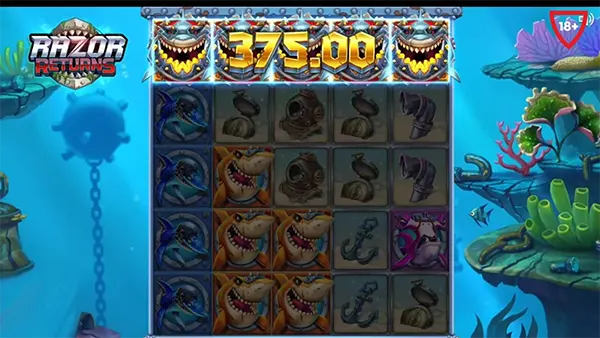
The feature you’ll see most often is the stacked Mystery Symbols behaviour that triggers Nudge & Reveal. When stacks land, the visible mystery positions open to reveal a symbol set for that step, then the stacks nudge by one position on subsequent spins until they move off the grid.
This matters for variance because the reveal can produce either routine paying symbols or special outcomes (wild-related and “enhanced” behaviour depending on the state). In other words, the same trigger can result in a forgettable small hit or the start of a sequence that escalates quickly.
From a risk standpoint, the key is that Nudge & Reveal creates “lumpiness”: wins can arrive in bursts when multiple nudges cooperate, rather than in a steady trickle. That bursty pattern is a hallmark of high-variance design.
Push Bet and why a 10% cost add-on changes the maths
Outside the UK, Razor Returns may offer Push Bet: you pay 10% extra per spin, and in return the published RTP increases (commonly from 96.16% to 96.55% with Push Bet active). It’s not a magic switch, but it is one of the few player-facing toggles that has a measurable effect on theoretical return.
More important than the RTP bump is the shift in max-win hit-rate that’s often reported with the feature. In the same data sets, the max-win probability improves dramatically (cited around 1 in 27 million spins with Push Bet), which is still very rare, but meaningfully less remote than the baseline figure.
The trade-off is straightforward: you are buying a better shot at the tail-end outcomes, and you pay for it every spin. If you’re bankroll-limited, the added cost can shorten sessions; if you’re explicitly chasing the highest-ceiling outcomes, it can be a rational option—provided you accept the higher burn rate.
Bonus entry options and how they change the risk profile
Free Spins are triggered by 3+ scatter symbols (torpedoes) landing in view, and the number of scatters affects the starting multiplier. A commonly cited setup is x1 for 3 scatters, x5 for 4, and x25 for 5, which is a big difference in potential from the very first free spin.
During Free Spins, reels 2 and 4 are filled with Mystery Symbols from the start, and they nudge down by one position each spin. Each nudge also increases the total multiplier by +1, and new mystery stacks can land to extend the feature—so a long bonus can compound value even if early spins are quiet.
This structure pushes the game’s risk upward in two ways: first, outcomes are concentrated into bonus rounds; second, within the bonus round, value can be heavily backloaded (the later part of the sequence can be far more valuable than the start).
Bonus Buy prices (where available) and what they imply for budgeting
Outside the UK, published bonus-buy menus commonly list several entry points, each priced as a multiple of stake. Examples include buying 3-scatter Free Spins for 106x stake, 4-scatter Free Spins for 186x, and 5-scatter Free Spins for 550x, plus a Random Free Spins option around 200x.
Those tiers are effectively different risk products. The cheaper entries can produce more frequent, smaller bonuses, while the 5-scatter buy front-loads a high starting multiplier and can be viewed as paying for a higher ceiling and a better “immediate” feature profile—at a steep cost.
If you treat bonus buys as single “events”, it helps to translate them into a session plan: how many attempts can you actually afford, and what result would count as acceptable. Because variance remains high even inside the feature, the safest assumption is that a meaningful portion of buys will underperform expectations.