
Honey Rush Black & Yellow by Play’n GO: Slot Review with a Bee-Inspired Theme

Honey Rush Black & Yellow by Play’n GO is a modern online slot that combines a vibrant insect theme with mechanics inspired by cascading reels and cluster-based wins. Released as an extension of the original Honey Rush concept, this version focuses on darker tones, increased volatility, and a more structured bonus system. The game reflects Play’n GO’s approach to slot design in 2026, where visual identity, mathematical balance, and replay value are developed with careful attention to player behaviour and long-term engagement.
Game Overview and Core Features
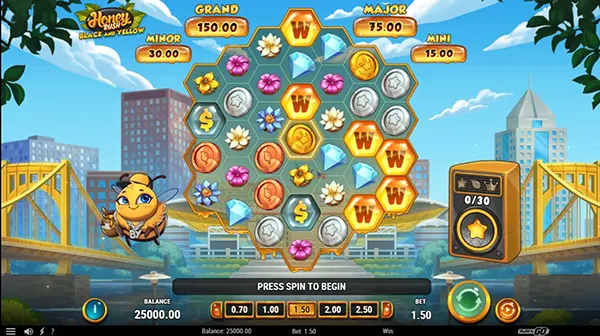
The slot is built on a 5×5 grid rather than traditional paylines, using a cluster pays system where wins are triggered by connecting matching symbols. This mechanic encourages dynamic gameplay, as symbols drop and refill the grid after each win, creating potential for consecutive payouts within a single spin. The interface is intuitive, with a focus on clarity and responsiveness across both desktop and mobile devices.
Honey Rush Black & Yellow operates with medium-to-high volatility, meaning that while wins may not occur on every spin, they tend to carry more weight when they do. The RTP (Return to Player) is typically around 96.2%, which aligns with industry averages for similar cluster-based slots. This balance makes the game suitable for players who prefer sessions with fluctuating results rather than constant low-value wins.
One of the defining elements is the multiplier system, which increases during consecutive winning cascades. Each successful drop enhances the multiplier level, potentially leading to significantly higher payouts if the chain continues. This feature adds a strategic layer, as players often aim to sustain cascades rather than rely on isolated wins.
Visual Design and Theme Execution
The visual identity of the slot is centred around a stylised bee environment, combining black-and-yellow colour schemes with honeycomb structures. Unlike more traditional nature-themed slots, this version adopts a slightly darker aesthetic, which gives it a more distinctive tone compared to its predecessor. The design remains clean and avoids unnecessary visual clutter.
Animations are smooth and serve a functional purpose rather than being purely decorative. When clusters form and disappear, the transitions are immediate, ensuring that gameplay remains fast-paced. Sound effects complement the theme with subtle buzzing tones and ambient background music that does not distract from the core experience.
Overall, the presentation aligns with Play’n GO’s design philosophy: clear visuals, recognisable symbols, and consistent thematic elements that support gameplay rather than overpower it. This makes the slot accessible even during longer sessions.
Bonus Mechanics and Special Features
The game includes several special mechanics that differentiate it from standard cluster slots. The most notable is the Honey Pot feature, where specific symbols contribute to filling a meter that eventually triggers bonus effects. These can include additional multipliers or extended cascade opportunities.
Another key element is the Wild system. Wild symbols not only substitute for regular icons but can also appear with multipliers attached. When included in a winning cluster, these multipliers are applied to the total win, significantly increasing payout potential during favourable sequences.
Free Spins are activated through scatter-like mechanics, usually tied to collecting specific symbols over multiple spins. During the bonus round, multipliers often start at a higher base level, giving players a stronger chance of achieving larger cumulative wins.
How the Multiplier System Works
The multiplier system is central to the gameplay structure. Each consecutive cascade increases the multiplier step-by-step, often starting from x1 and rising with every successful drop. This progression resets once no new winning clusters appear, which adds tension to each spin.
In bonus rounds, the multiplier typically carries over between cascades more aggressively, allowing players to reach higher levels faster. This design encourages longer engagement with bonus features, as the potential for larger payouts becomes more realistic over time.
From a mathematical perspective, this system increases volatility while maintaining fairness. It rewards persistence within a single spin rather than relying solely on random high-value hits, which aligns with modern slot design trends observed in 2026.
Strategy, RTP, and Player Considerations
While slots are primarily games of chance, understanding volatility and feature frequency can help shape a more controlled approach. In Honey Rush Black & Yellow, players should be prepared for uneven win distribution, as the game is designed to deliver results in bursts rather than consistent returns.
Bankroll management is particularly important due to the cluster mechanics and multiplier scaling. Short sessions may not fully reflect the game’s potential, as larger wins often depend on extended cascades or bonus activation. Adjusting bet size according to session length can help maintain balance.
The RTP of approximately 96.2% indicates that the game performs within standard expectations over time, though actual results vary significantly in shorter sessions. This makes it suitable for players who prefer a mix of risk and reward rather than predictable outcomes.
Who This Slot Is Best Suited For
This slot is most suitable for players who enjoy cluster-based mechanics and are familiar with cascading systems. Those who prefer traditional paylines may find the format less intuitive at first, but the learning curve is relatively short.
It also appeals to users who value structured bonus features rather than purely random triggers. The presence of multipliers, progression elements, and feature accumulation creates a sense of development during gameplay.
For players seeking visually simple yet mechanically layered slots, Honey Rush Black & Yellow offers a balanced experience. Its design avoids excessive complexity while still providing enough depth to remain engaging over repeated sessions.