
Reactoonz (Play’n GO): cluster wins, Gargantoon charging, and how to read bonus behaviour during a session
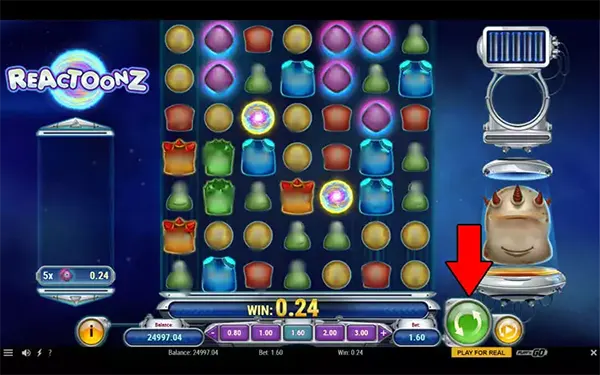
Reactoonz looks light-hearted, yet it is built around a very deliberate mathematical model. Instead of paylines, it uses a 7×7 grid where wins are paid for clusters of five or more matching symbols that touch horizontally or vertically. Every time a cluster is removed, the grid refills, which can create several cascades from a single paid spin. That cascade mechanic is the reason why Reactoonz still holds attention in 2026: a session can stay quiet for long stretches, then suddenly turn into a chain of bonus activity.
How cluster wins and cascades actually shape your session
The most important shift for many players is understanding that you are not “chasing a line hit” here. You are chasing symbol density and connections. A cluster win is formed when five or more identical symbols connect, and once it happens, those symbols disappear and new ones drop in. This system creates a natural momentum effect: the more clusters you land, the more chances you get for extra clusters without buying another spin.
In practice, this is why Reactoonz often feels like it moves in waves. Some periods deliver little or nothing, because the grid lands in a scattered way with no meaningful connections. Then the game can suddenly produce a sequence of cascades where wins repeatedly form on fresh drops. Even when the initial cluster is small, a follow-up cascade can generate a bigger group, especially if wilds or special effects appear during the refill.
Because of this structure, Reactoonz is generally classed as a high-volatility slot. Many spins can produce no payout at all, while a smaller portion of spins will carry most of the return through long cascade chains or feature outcomes. That volatility is also why two sessions can feel completely different even at the same stake, which is why the game remains a strong example of why bankroll management matters more than “spin count”.
Why the grid can feel “sticky” or “dry” and what that usually means
Players often describe Reactoonz sessions as either “sticky” or “dry”. A sticky phase is when the grid keeps producing clusters in the same general areas, triggering frequent cascades. A dry phase is when symbols arrive in a way that refuses to connect, and you get repeated dead spins. These feelings are a natural consequence of cluster mathematics: if symbols scatter evenly, clusters are rare; if they land in concentrated pockets, cascades can feed into more cascades.
It helps to watch how often your wins come with at least two drops. A single small cluster without follow-up is usually just noise. If you keep seeing multi-drop sequences, it is a sign that the grid is connecting well, and that can influence how quickly the game moves towards feature activity. This is not a prediction tool, but it is a useful way to understand whether your current session is “working with you” or simply grinding.
The key discipline point is simple: a dry stretch does not mean the game “owes” you a feature. High-volatility slots often punish the belief that a bonus is due. If a session feels consistently dry, the most sensible reaction is to slow down, take a break, or stop, rather than increasing stakes in frustration.
Charging Gargantoon: what fills the Quantum meter and what triggers features
Reactoonz revolves around a Quantum meter that fills as you land winning clusters. Every time you remove symbols through a win, you contribute to the meter’s progress. As the meter reaches specific thresholds, the game can trigger Quantum features, and when it becomes fully charged, the Gargantoon wild appears. This structure is one reason the game feels narrative: you are not waiting for random free spins, you are building towards events through ordinary gameplay.
From a player’s point of view, the most useful takeaway is that meter progress is connected to how active your wins are. Small clusters charge it slowly, and long periods of dead spins charge it not at all. Larger clusters and multi-cascade sequences can move it forward much faster. That’s why “time spent spinning” is not a reliable indicator of when you might see a feature — two people can play the same number of spins and have totally different Quantum progress.
When Gargantoon finally arrives, it appears as a large wild block that takes up a significant part of the grid. It can be extremely valuable because it helps connect symbols and enables larger cluster formations. However, the outcome still depends on what lands around it. Gargantoon can create a major win if it links into premium clusters and cascades, but it can also land in a situation where it looks impressive yet produces only modest payout.
How to interpret “bonus behaviour” while you play (without pretending it’s predictable)
Reactoonz encourages players to “read” the session because the meter is visible and the grid behaviour is obvious. But reading behaviour is not the same as predicting results. What you can realistically observe is whether your session is producing frequent clusters and progress, or whether it is failing to connect and therefore staying feature-light. That observation can help you pace your play, but it should never be used as a reason to chase losses.
A practical approach is to compare how costly it feels to reach the early feature thresholds. If it takes a long time and gives weak returns, the session may feel grindy, which is exactly when people start making emotional decisions. If features arrive more often and cascades feel more energetic, you may be in a more event-heavy phase — but that can also lead to overconfidence. Both states are temporary and neither is “proof” of what comes next.
Gargantoon is the biggest psychological trigger in the game because it feels like a major moment. Many players unconsciously treat it as a guarantee of a strong payout. In reality it is a high-impact mechanic, not a promise. If you want a stable mindset in 2026, assume Gargantoon outcomes can vary widely and make sure your session rules do not rely on any single feature saving your bankroll.
Practical session strategy: reading momentum, managing volatility, staying disciplined
Reactoonz does not reward complex “systems”. What it rewards is controlled session design. Because the game’s volatility is high, your biggest advantage is choosing a stake that lets you survive slow periods without stress. If every dry run makes you feel pressured, the stake is likely too high for your bankroll, which is when chasing behaviour begins.
A sensible method is to treat your budget as a fixed tool rather than an emotional cushion. Decide how much you are willing to lose before you start, and also decide what a “good win” looks like for you. Because Reactoonz can produce sudden spikes, players often stay too long after a strong feature run, hoping for another. That is how a good session turns into a long, costly one.
It is also worth remembering that the same game title can exist with different RTP configurations depending on the operator. Two versions can look identical yet return different long-term value. If you are reviewing Reactoonz in 2026, it is good practice to verify the RTP shown in the game’s information panel rather than assuming the default figure applies everywhere.
A simple checklist for “reading” the session while keeping control
First, watch cascade depth. If you rarely see multi-drop sequences, your meter progress will likely be slow and the session may remain quiet. That is not a flaw — it is normal volatility — but it is a cue to manage your pace and avoid emotional adjustments. If you planned a short session, don’t extend it just because you “haven’t seen anything yet”.
Second, monitor feature density. When Quantum modifiers begin to appear more often, it can feel like the game is heating up. This is not the moment to raise your stake. If anything, it is the moment to protect your winnings and keep your decisions consistent. Slots often feel most persuasive right before they return to normal variance, and Reactoonz is particularly good at creating that illusion through animation and grid movement.
Third, decide what you do after Gargantoon appears. Many players keep playing simply because they want to see it again. A healthier habit is to set a rule in advance: after a major feature, you either stop, reduce stake, or take a timed break. That single rule prevents the session from drifting into chasing and keeps the game enjoyable rather than stressful.